
Idaho ITD Permit Practice Test 5
Test 5 of 10. Pick an answer for each question to see if it is right and why; your score appears at the end. You need 34 correct answers to pass, the same ratio as the real Idaho test.

- Questions40
- Correct to pass34
- Passing score85%
- Minimum age15 years
-
1. Roughly how far does a vehicle travel at 55 mph during the few seconds a driver spends reading a text message?
Show answer
Answer D: About the length of a football field
Sending or reading a message takes the eyes off the road for about five seconds, which at 55 mph covers roughly the length of a football field with nobody watching the road.
-
2. You see an open curb space on the opposite side of a two-way street. What should you do?
Show answer
Answer B: Drive on, turn around, and come back on that side
You must park on the right, facing the direction of travel, so reaching a space on the other side means going around rather than crossing into it.
-
3. Your car begins to lose power on a freeway and you must stop. Where should you try to bring it to a halt?
Show answer
Answer A: As far off the right side of the road as you can get, beyond the edge line
A disabled vehicle should be moved completely clear of the travel lanes, on the right, so that traffic can pass without changing course.
-
4. A yellow lamp flashes above a warning sign at a sharp curve. What does it ask of a driver?
Show answer
Answer D: Slow down and pass the point with extra care
A warning beacon draws attention to the sign it is mounted with, and the message of the sign is what the driver must act on.
-
5. During the first six months after an Idaho driver under 17 is licensed, what passenger limit applies?
Show answer
Answer A: No more than one passenger under 17 unless the passengers are related by blood, adoption or marriage
For the first six months of licensing, an Idaho driver under 17 may carry only one passenger under the age of 17 unless the passengers are family by blood, adoption or marriage.
-
6. When may an Idaho Class D skills test be scheduled?
Show answer
Answer C: Only during daylight hours and in acceptable weather conditions
Idaho restricts Class D skills tests to daylight hours and acceptable weather, and a test may be rescheduled when conditions do not meet that standard.
-
7. The brake pedal goes to the floor and the vehicle does not slow. What should you try first?
Show answer
Answer C: Pump the pedal quickly to try to build pressure
Most vehicles have a split braking system, so rapid pumping can often build enough pressure to slow you. If it does not, use the parking brake gradually.
-
8. After turning right you see a sign showing that your lane ends a short way ahead. What should you do?
Show answer
Answer B: Signal and merge into the next lane while there is still room
Merge early and smoothly while a gap is still available, rather than running out of pavement or forcing your way in at the last moment.
-
9. You are clear of the tracks after your vehicle stalled on a crossing. Whom should you contact?
Show answer
Answer C: The emergency number posted on the blue sign at the crossing, or 911
Grade crossings carry an emergency notification sign with a railroad phone number and a crossing identification number so that approaching trains can be stopped, and 911 works if that sign is not visible.
-
10. A yellow pennant, an isosceles triangle with its long axis horizontal, is reserved for which message?
Show answer
Answer D: No passing zone
The pennant shape is used only for the no passing zone sign, which marks the point where overtaking is no longer allowed.
-
11. After an hour on a hot highway your tire pressure reads higher than it did in the morning. What should you do?
Show answer
Answer D: Nothing, because pressure rises when tires heat up
Air expands as the tire warms, so a hot reading is normally above the cold setting. Bleeding air off would leave the tire underinflated once it cooled.
-
12. A wheel comes off your car while you are driving. What should you do?
Show answer
Answer A: Hold the wheel firmly, ease off the gas and steer gently to the shoulder
A firm grip and a gradual slowing keep the vehicle straight, while hard or sudden braking makes a damaged corner pull the car out of line.
-
13. Your power steering fails while you are driving. What happens and what should you do?
Show answer
Answer B: Steering becomes much harder but still works, so slow down and pull off the road
Without power assistance the steering still works, but it takes much more effort, especially at low speed. Keep both hands on the wheel and get off the road.
-
14. How current must an Idaho verification of school compliance document be when it is presented?
Show answer
Answer A: It must be presented within one year of the date shown on the document
ITD requires the verification of compliance to be presented within one year of the date listed on the document.
-
15. How far ahead must Idaho headlights reveal people and vehicles?
Show answer
Answer A: At least 350 feet on high beam and at least 100 feet on low beam
Idaho requires high beams to show people and vehicles at least 350 feet away and low beams to light the roadway at least 100 feet ahead.
-
16. How much supervised driving time must an Idaho GDL permit holder accumulate, and how much of it must be at night?
Show answer
Answer C: 50 hours total, with at least 10 hours at night
Idaho requires at least 50 hours of supervised driving during the instruction period, ten of which must be completed at night.
-
17. In Idaho, what alcohol concentration triggers the enhanced penalties reserved for excessive DUI levels?
Show answer
Answer D: .20 or more
Idaho law provides stiffer penalties for a driver whose alcohol concentration is .20 or more, on top of the ordinary .08 threshold for drivers 21 and older.
-
18. You stop at a rest area because you are sleepy. How long a nap is usually recommended?
Show answer
Answer D: About fifteen to twenty minutes
A short nap of fifteen to twenty minutes restores useful alertness without leaving the grogginess a longer sleep can bring, and you should wait a few minutes before driving on.
-
19. You are turning left at an intersection just beyond the crest of a hill. What is the added risk?
Show answer
Answer B: Oncoming vehicles appear with very little warning and close quickly
A crest hides approaching traffic until it is close, so the gap you thought was empty can fill in the time the turn takes.
-
20. You are turning right on a red light where that is permitted. What does the law require first?
Show answer
Answer B: A full stop, then yielding to traffic and pedestrians
A right turn on red is allowed only after stopping completely and giving way to everyone who has the green, including people in the crosswalk.
-
21. What blood alcohol concentration makes a driver under 21 guilty of driving under the influence in Idaho?
Show answer
Answer C: .02 or more
Idaho law sets the driving under the influence threshold at .02 or more for drivers under 21, well below the .08 that applies to drivers 21 and older.
-
22. At what breath alcohol concentration will an Idaho-certified ignition interlock stop a vehicle from starting?
Show answer
Answer C: .025 or greater
Ignition interlock devices certified by ITD lock the vehicle out at a breath alcohol concentration of .025 or greater.
-
23. In a work zone one lane sits an inch or two lower than the lane beside it. How should you change lanes?
Show answer
Answer C: Slow down and cross the edge at a shallow angle, holding the wheel firmly
A vertical edge between lanes can catch a tire and jerk the steering. Crossing slowly at a shallow angle lets the wheel climb without grabbing.
-
24. There is a driveway and a side street between you and the corner where you will turn right. When should you signal?
Show answer
Answer C: After passing the openings, so nobody pulls out in front of you
A signal switched on before an opening tells drivers waiting there that you are turning in, and they may pull out into your path.
-
25. Which facility does this sign direct a traveler toward?

Show answer
Answer B: A hospital offering emergency care
This is the standard marker for medical care, used to lead a traveler to a hospital where emergency treatment is available.
-
26. An Idaho license is about to expire while the holder is temporarily out of state. What may the holder apply for?
Show answer
Answer C: An extension of up to 12 months for $10, with one further extension possible
Idaho lets a driver who is temporarily out of state apply for an extension of up to 12 months for $10 and, if necessary, request a second and final 12-month extension.
-
27. What is the driver expected to do after passing this sign?
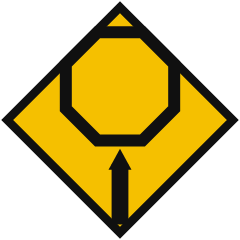
Show answer
Answer A: Begin slowing so that a complete stop can be made at the intersection ahead
It is used where the control at the intersection stays hidden until late, so braking should begin here rather than at the stop line.
-
28. You see brake lights several vehicles ahead of you in your lane. What is the best first step?
Show answer
Answer C: Ease off the gas and cover the brake pedal
Reacting to the trouble several vehicles ahead, rather than waiting for the car in front, cuts your reaction time and warns the driver behind you.
-
29. You approach a stopped tow truck with lights flashing on an Idaho road with one lane in each direction. What does the law require?
Show answer
Answer C: Reduce speed below the posted limit and proceed with caution
Idaho requires drivers to reduce speed below the posted limit and proceed with caution; the additional duty to change lanes applies only where there are two or more lanes in the same direction.
-
30. A farm implement ahead of you on a two-lane road is wider than its own lane. What should you do?
Show answer
Answer D: Hang back until you can see past it and pass only with a clear road
Wide equipment hides the road ahead and may extend farther across the center line than it appears, so the pass needs more room and a much better view.
-
31. You have finished parallel parking at the curb. How should the vehicle sit?
Show answer
Answer A: Close to the curb, so that it does not stick out into the traffic lane
A parked vehicle must sit close enough to the curb that it does not intrude into the path of passing traffic; the exact maximum distance is set by each state.
-
32. You have printed directions or paperwork you need to check. When should you read them?
Show answer
Answer C: Before you leave, or after you park
Reading takes eyes and mind off the road for far longer than any safe glance, and a light that changes while you read leaves you moving off blind.
-
33. What is distinctive about the suspension periods imposed under Idaho's graduated driver's license penalties?
Show answer
Answer B: They are absolute and allow no driving privileges of any kind
The GDL penalty suspensions are absolute and permit no driving privileges of any kind, and they apply on top of any permit cancellation or court-ordered suspension.
-
34. A driver leaves the vehicle at the curb where this sign is posted and walks away for two minutes. Is that allowed?
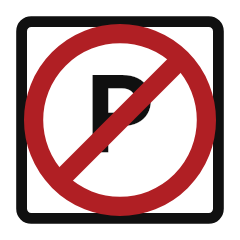
Show answer
Answer B: No, leaving the vehicle unattended there is prohibited whatever the length of the absence
Walking away leaves the vehicle parked, and the prohibition holds regardless of how long the driver is gone or whether the engine is left running.
-
35. The stability control warning light flashes while you are driving through a curve. What does it mean?
Show answer
Answer A: The system is actively working to keep the vehicle under control, so slow down
A flashing stability control light means the system is braking individual wheels because you are near the limit of grip. Ease off and drive more gently.
-
36. How far ahead should you normally be looking while driving?
Show answer
Answer D: About 12 to 15 seconds of travel ahead
Looking that far ahead, roughly a block in town and much farther on a highway, gives you time to see a problem developing and adjust before it becomes an emergency.
-
37. The green arrow protecting your turn changes to a steady yellow arrow. What is it telling you?
Show answer
Answer A: The protected turn is ending and you should prepare to stop
A steady yellow arrow warns that the arrow movement is being terminated and that a red indication will follow.
-
38. What is the safest way to deal with a vehicle sitting in your blind spot?
Show answer
Answer A: Slow a little or move ahead so that it is no longer beside you
You cannot control the other driver, but you can change your own speed so that the vehicle is no longer hidden beside you.
-
39. A tractor-trailer is backing slowly across the roadway to enter a loading dock. What should you do?
Show answer
Answer C: Stop and wait until the truck has finished the maneuver
A backing truck driver has a very limited view and the trailer can swing unexpectedly. Trying to squeeze past in either direction risks being crushed.
-
40. Where are signs of this kind placed at an intersection?
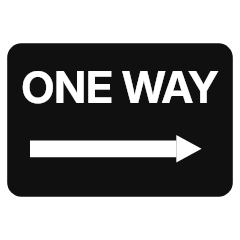
Show answer
Answer C: At the near right and far left corners, facing drivers on the intersecting street
They are installed at the corners of the intersecting street so that a driver about to turn in sees the restriction before committing to the turn.