
Idaho ITD Permit Practice Test 1
Test 1 of 10. Pick an answer for each question to see if it is right and why; your score appears at the end. You need 34 correct answers to pass, the same ratio as the real Idaho test.

- Questions40
- Correct to pass34
- Passing score85%
- Minimum age15 years
-
1. What is the benefit of looking far down the road rather than just ahead of the hood?
Show answer
Answer A: You steer with smaller corrections and you see trouble in plenty of time
A distant view steadies your steering and gives you time to plan, because you meet hazards after you have already seen them.
-
2. You are traveling beside another vehicle on a multilane highway at nearly the same speed. Why is this a poor position?
Show answer
Answer B: You may be sitting in that driver's blind spot with nowhere to go if they move over
Driving alongside removes your side escape route and often puts you where the other driver cannot see you. Speed up or drop back to open space beside you.
-
3. Your vehicle breaks down on a busy highway. What is the safest course of action?
Show answer
Answer D: Get it as far off the roadway as possible, switch on the hazard lights and keep clear of the traffic lanes
A vehicle left in or beside a travel lane is a hazard, so move it well off the road, make it conspicuous with hazard lights and keep yourself away from passing traffic.
-
4. What does Idaho ask of drivers who meet an oncoming pilot vehicle escorting an oversized load?
Show answer
Answer C: Reduce speed and position your vehicle as far to the right as possible
When meeting an oncoming pilot vehicle with amber warning lights, Idaho drivers should reduce speed and position themselves as far to the right as possible.
-
5. Two lanes at the corner are marked for right turns. What does that require of you?
Show answer
Answer A: Keep your own lane through the turn and into the matching new lane
Dual turn lanes work only if each vehicle stays in its own lane all the way round and finishes in the corresponding lane of the new street.
-
6. Why is a wet road at night harder to read than the same road in daylight?
Show answer
Answer A: The wet surface reflects light away and swallows the lane markings
A film of water sends your headlight beam onward instead of back to you, so lines, edges and people in dark clothing almost disappear.
-
7. Why should you not switch the engine off while the vehicle is still moving fast?
Show answer
Answer B: You lose power steering and the steering may lock
With the engine off the steering becomes very heavy and on many vehicles the column can lock, so shift to neutral first and only shut down once stopped.
-
8. What must you be sure of before you pull out to pass on a two-lane road?
Show answer
Answer A: That the road ahead is clear far enough for the whole pass
You need enough clear road to pull out, pass and return before any oncoming vehicle arrives, and you must judge that distance before you start.
-
9. A traffic signal ahead is showing a flashing red light. What does it require?
Show answer
Answer C: Stop completely, then go when the way is clear, as at a stop sign
A flashing red light has the same meaning as a stop sign: stop completely, yield to traffic and pedestrians, then proceed when it is safe.
-
10. You have to leave a trailer parked on a slope. What extra step protects it?
Show answer
Answer D: Chock the trailer wheels as well as setting the brake
Chocks physically block the wheels, which is the only thing that still holds if a brake or a coupling lets go.
-
11. You are turning right from a one-way street onto a two-way street. Where should the turn end?
Show answer
Answer A: In the lane nearest the right curb of the street you are entering
A right turn starts and finishes as close to the right as practical, so you leave the one-way street from the right lane and arrive in the lane nearest the right curb.
-
12. How many scored errors may an applicant make on the Idaho Class D skills test and still pass?
Show answer
Answer D: Twelve or fewer errors
Idaho scores the Class D skills test against a list of driving skills and treats twelve or fewer errors as a passing result, provided no critical driving error occurs.
-
13. Your left-turn lane faces a steady green ball and oncoming traffic is heavy. What are you allowed to do?
Show answer
Answer C: Move into the intersection and turn when a safe gap appears
A green ball permits the turn but gives no priority, so you may move into the intersection and wait there for a gap in the oncoming traffic.
-
14. How does a wet road change the distance you need to stop?
Show answer
Answer C: It lengthens it, so you need a much bigger gap ahead
Water between the tire and the road cuts grip, so braking distance grows and the gap that works on dry pavement is no longer enough.
-
15. When are the hazard warning lights properly used?
Show answer
Answer A: When your vehicle is stopped or barely moving and is a hazard
Hazard lights warn that your vehicle is an obstruction; they do not authorize illegal parking and they hide your turn signals while driving.
-
16. In normal operation, which indication always comes between a green and a red on the same signal face?
Show answer
Answer C: A steady yellow
The yellow change interval must follow every green or green arrow, so a signal can never jump straight from green to red.
-
17. The red brake warning light stays on after you release the parking brake. What should you do?
Show answer
Answer D: Stop safely and have the brakes checked before driving on
With the parking brake released, that light points to low fluid or a fault in one half of the braking system, which can leave you with very little braking.
-
18. You are driving down a parking aisle and reach the main lane that runs along the front of the store. What is the usual rule?
Show answer
Answer C: The main through lane has the right of way over the vehicles leaving the aisles
In a parking lot the wide lane that runs across the ends of the aisles works like a through road, and drivers leaving an aisle yield to it.
-
19. What fee must an Idaho vehicle owner pay to reinstate a registration suspended for lack of insurance?
Show answer
Answer A: $75
Idaho charges a $75 reinstatement fee, along with proof of insurance, to restore a registration suspended under the Drive Insured program.
-
20. In Idaho, 24 or more points in any 36-month period results in what?
Show answer
Answer A: A six-month suspension
The top band of Idaho's point system, 24 or more points in any 36 months, carries a six-month suspension.
-
21. What license suspension does a first Idaho DUI conviction carry for a driver 21 or older?
Show answer
Answer D: At least 90 days and up to 180 days, with no driving privileges for the first 30
A first Idaho DUI conviction brings a mandatory suspension of at least 90 days and up to 180 days, with absolutely no driving privileges during the first 30 days.
-
22. What does Idaho law allow a bicyclist to do at a stop sign?
Show answer
Answer D: Slow, yield the right of way and then proceed without a complete stop
Idaho does not require bicyclists to come to a complete stop at a stop sign; they must yield to vehicles in or approaching the intersection and then proceed with caution.
-
23. You have just driven through a deep puddle and your brakes feel weak. What should you do?
Show answer
Answer D: Drive slowly while lightly applying the brakes until they dry and work normally
Wet brakes grip poorly and may pull to one side. Gentle braking at low speed generates heat that dries the pads and discs quickly.
-
24. After a suspension for a serious offense such as reckless driving or driving under the influence, how long must an Idaho driver provide proof of financial responsibility?
Show answer
Answer B: Three years
Idaho requires three years of proof of financial responsibility, in the form of an SR-22 certificate from the insurer, after certain serious offenses.
-
25. How close to a fire hydrant may a vehicle be parked in Idaho?
Show answer
Answer B: No closer than 15 feet
Idaho prohibits parking within 15 feet of a fire hydrant, within 20 feet of a crosswalk and within 30 feet of a stop sign, yield sign or traffic signal.
-
26. A deer suddenly steps onto the road ahead of you at night. What is the safest response?
Show answer
Answer C: Brake firmly and stay in your lane rather than swerving
Swerving at speed often leads to a rollover or a head-on crash that is far worse than hitting the animal. Brake hard, hold your lane and expect more deer to follow.
-
27. What does an approved Idaho driver training program consist of?
Show answer
Answer A: 30 hours of classroom instruction, 6 hours of in-car observation and 6 hours of behind-the-wheel driving
Idaho requires 30 hours of classroom work, six hours observing other student drivers from inside the car and six hours of behind-the-wheel practice with an approved instructor.
-
28. Which color scheme is standard for the drums and barricades that channel traffic through a work zone?
Show answer
Answer C: Alternating orange and white retroreflective stripes
Drums and barricades carry alternating orange and white retroreflective stripes, and the traffic cones used in the same zones are predominantly orange.
-
29. Unless otherwise posted, what is the maximum speed on Idaho interstate highways?
Show answer
Answer A: 75 miles per hour, with 80 allowed where posted
Idaho sets 75 miles per hour as the interstate maximum unless otherwise posted, and 80 miles per hour may be allowed where it is specifically posted.
-
30. Cones and drums mark a shifted lane through a work zone. What should you do?
Show answer
Answer A: Follow the path that they mark and stay inside it
Channelizing devices define the temporary travel path, and the space on the other side of them belongs to the workers.
-
31. A school crossing guard steps into the roadway and holds up a stop paddle. What must you do?
Show answer
Answer D: Stop and stay stopped until the guard and the children have left the road
A crossing guard directs traffic with legal authority; you must remain stopped until both the guard and the children are clear of the roadway.
-
32. What does a sign reading Slower Traffic Keep Right require?
Show answer
Answer C: Traffic moving slower than the general flow must use the right-hand lane
The sign applies to any vehicle traveling below the speed of the traffic around it, which must keep right so faster vehicles can use the lanes to the left.
-
33. What must an Idaho driver do before completing a defensive driving course if the three-point reduction is to be approved?
Show answer
Answer D: Pay the citation
ITD requires citations to be paid before the defensive driving course is completed for the three-point reduction to be approved.
-
34. The added lane warning sign tells a driver that
Show answer
Answer A: an extra lane begins ahead, so entering traffic does not have to merge into an existing lane
Where a lane is added, traffic entering the roadway gets a lane of its own, so merging is not required, although drivers should still watch the vehicles beside them.
-
35. A rectangular marker with alternating black and retroreflective yellow stripes set at a slant is used to
Show answer
Answer C: mark an obstruction, with the stripes sloping down toward the side on which traffic should pass
This striped panel is an object marker, and the direction in which the stripes slope shows the driver which side of the obstruction to pass on.
-
36. Which sign tells you that the vehicles ahead are part of a funeral procession?
Show answer
Answer C: Headlights burning in daylight, with small flags or markers on the vehicles
Processions are normally identified by daytime headlights, hazard lights and flags or windshield markers, not by emergency lights or sirens.
-
37. How far should the driver chest be from the steering wheel?
Show answer
Answer B: At least about ten inches
The airbag deploys with great force in the first instants of a crash, so about ten inches between your chest and the wheel is the recommended minimum.
-
38. A yellow diamond shows an arrow that doubles back on itself. What kind of curve lies ahead?
Show answer
Answer C: A turn of 135 degrees or more, nearly doubling back
The hairpin curve sign is used where the road changes direction by 135 degrees or more, and it is normally backed up by chevrons or a large arrow through the bend.
-
39. At what tread depth should a tire be replaced?
Show answer
Answer A: When the tread is worn down to 2/32 of an inch
At that depth a tire loses grip quickly, especially on wet roads, and the built in wear bars or the penny test both show when the point has been reached.
-
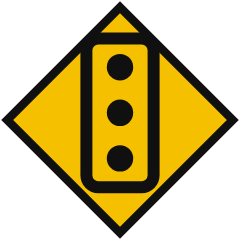
40. What does this sign require of the driver?
Show answer
Answer D: Reducing speed and being ready to stop at the intersection ahead
The advance notice asks the driver to slow and be ready to stop, while whether a stop is actually needed depends on the indication displayed on arrival.