
Idaho ITD Motorcycle Practice Test 52
- Questions25
- Correct to pass20
- Passing score80%
- Minimum ageSee note
-
1. Enhanced reference location markers differ from ordinary mileposts in that they
Show answer
Answer B: carry the route number and a mileage figure to the tenth of a mile
An enhanced reference location marker adds the route designation and carries the mileage to a tenth, so the point named is far more precise than a plain milepost.
-
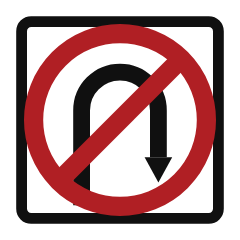
2. Why is this restriction used so often on a divided road just before a crest or a bend?
Show answer
Answer A: Because a vehicle turning across the median there stays hidden from approaching drivers until it is too late
The maneuver needs a long gap and good visibility, and where sight distance is short an approaching driver has no time to react to a vehicle turning across the road.
-
3. You need to leave the road and pull onto the shoulder. What should you check first?
Show answer
Answer A: Whether the shoulder surface is firm enough to support the motorcycle
Soft or loose shoulder material can grab the wheels or let the side stand sink, so confirm the surface is firm, signal, and then pull well clear of traffic.
-
4. Which formation lets a group of riders stay close together while every rider keeps an adequate space cushion?
Show answer
Answer A: A staggered formation
A staggered formation keeps the group compact enough for traffic while still leaving each rider room to the front, the rear and both sides.
-
5. What should a passenger hold on to while the motorcycle is moving?
Show answer
Answer B: The operator's waist, hips or belt, or a handhold provided for the passenger
Holding the operator's waist, hips or belt, or a handhold designed for the passenger, keeps the passenger secure under acceleration and braking without pulling the operator off balance.
-
6. A line of short dashes set closer together than an ordinary lane line runs beside your lane where a ramp leaves the highway. What does a dotted line of that kind convey?
Show answer
Answer A: A warning that the lane is about to change function
Dotted lines give guidance or warning about a downstream change, such as a lane that becomes an exit only lane or a lane line carried across an intersection.
-
7. You are leaving a freeway at an exit that has a deceleration lane. Where should you slow down?
Show answer
Answer C: After you have moved fully into the exit lane
Braking in a through lane surprises the traffic behind you, so you move into the exit lane at highway speed and then slow down inside it.
-
8. On a two-lane road with a broken yellow center line, may you cross it to turn into a driveway on the left?
Show answer
Answer C: Yes, when it is safe and the oncoming lane is clear
A broken center line may be crossed for a pass or for a left turn into a road or a driveway, once the oncoming lane is clear.
-
9. You have just been involved in a crash on a city street. Which sequence of first steps is correct?
Show answer
Answer A: Stop where you are, check everyone for injuries, and then make the scene safe
You are required to stop, and the first priority at the scene is people, followed by preventing a second collision.
-
10. Your motorcycle starts to wander while you ride over rain grooves or a bridge grating. What should you do?
Show answer
Answer A: Relax, hold a steady speed and ride straight across
The wandering feeling on grooved surfaces and gratings is unsettling but generally not hazardous, while zigzagging to fight it is far more dangerous.
-
11. What is the main advantage of a face shield over goggles?
Show answer
Answer D: It protects the whole face, not only the eyes
Goggles keep wind and debris out of the eyes, but a shatter resistant face shield also protects the rest of the face in a crash.
-
12. You are approaching a yield sign and no other vehicle is anywhere in sight. What does the sign require?
Show answer
Answer A: Slow down and be ready to stop, but stop only if needed
A yield sign requires you to slow and give way, and to stop only when traffic or pedestrians make stopping necessary.
-
13. When should tire pressure be measured?
Show answer
Answer B: Before riding, while the tires are still cold
Riding heats the air inside a tire and raises the reading, so pressure is set cold to match the figure the manufacturer specifies.
-
14. In normal operation, which indication always comes between a green and a red on the same signal face?
Show answer
Answer C: A steady yellow
The yellow change interval must follow every green or green arrow, so a signal can never jump straight from green to red.
-
15. A yellow diamond showing a truck is posted beside a quarry entrance. What is it warning about?
Show answer
Answer A: Trucks turning onto the highway from that entrance
A truck crossing or trucks entering sign is used where heavy vehicles pull onto the road from a site, and they accelerate slowly once they are on it.
-
16. Why does riding in moderately cold weather call for extra layers of clothing?
Show answer
Answer B: Chill and fatigue set in quickly and reduce the rider's control
Wind at riding speed strips body heat away fast, and a chilled, tired rider reacts more slowly and can slide into hypothermia.
-
17. On a rural road, the driver of a slow farm tractor ahead of you signals a left turn even though there is no road or driveway in sight. What should you do?
Show answer
Answer B: Stay behind the tractor, because it may be turning into a field entrance
Farm equipment often turns into fields through gaps you cannot see, and it may swing wide to do so. Passing a vehicle that is signaling a left turn is a common cause of crashes.
-
18. You are turning left from a one-way street onto a two-way street. How should the turn be made?
Show answer
Answer B: Start in the far left lane and finish just to the right of the center line
Left turns begin from the lane nearest the left edge of the street you are leaving and must finish on the right-hand side of the center line of a two-way street.
-
19. You reach a stretch of road covered by moving flood water of unknown depth. What is the correct decision?
Show answer
Answer D: Turn around and take another route
About a foot of moving water is enough to carry away most cars, and the roadbed under the water may already be washed out, so the only safe choice is to turn around.
-
20. How long should a head check before a lane change last?
Show answer
Answer D: A quick glance, so you do not lose track of what is happening ahead
Traffic ahead can change in a second, so the blind spot check is a fast glance and the rider returns attention to the road immediately.
-
21. A mixed drink is made with two shots of spirits. How much alcohol is that?
Show answer
Answer C: About two standard drinks
A standard drink is a fixed amount of pure alcohol, so a glass poured with two measures counts as two drinks however it is served.
-
22. Another driver is behaving aggressively toward you. What should you do?
Show answer
Answer D: Avoid eye contact, give them room to go on their way and do not respond to provocation
Responding to an aggressive driver escalates the conflict, while creating distance and refusing to engage takes you out of the situation. Report serious threats once you can do so safely.
-
23. Your loaded vehicle weighs more than the figure shown on a posted weight limit sign. What must you do?
Show answer
Answer D: Find another route, because crossing is not permitted
A posted weight limit is a legal maximum, not advice, so an overweight vehicle has to take a different route.
-
24. A strong wind is blowing steadily across the road from your left. How should you ride?
Show answer
Answer A: Move toward the left of the lane and lean into the wind
Riding on the windward side of the lane leaves room to be pushed without leaving the lane, and a slight lean into the wind holds the line.
-
25. How should a rider use the head and eyes in a turn?
Show answer
Answer A: Turn only the head to look through the turn, keeping the eyes level with the horizon
Turning just the head keeps the upper body from upsetting the motorcycle, and level eyes help the rider judge lean angle and direction.