
Idaho ITD Motorcycle Practice Test 38
- Questions25
- Correct to pass20
- Passing score80%
- Minimum ageSee note
-
1. You are traveling in the same direction as a funeral procession and want to get ahead of it. What should you not do?
Show answer
Answer B: Driving in between the vehicles of the procession
Most states prohibit driving into or through a funeral procession, and cutting into the line leaves the drivers behind with no lead vehicle to follow, so go around only where passing is permitted.
-
2. The lights at a highway-rail grade crossing begin to flash red as you approach. What must you do?
Show answer
Answer B: Stop short of the tracks and wait until the lights stop and no train is near
Flashing red lights at a crossing require a stop clear of the tracks, and you may proceed only once the lights have stopped, any gates are fully raised and no train is approaching.
-
3. You are turning right where a paved trail crosses the road just past the corner. What should you look for?
Show answer
Answer B: Cyclists and walkers arriving from either direction on the trail
A shared use path carries two-way traffic on foot and on bicycles, so scan both directions along the trail before crossing it.
-
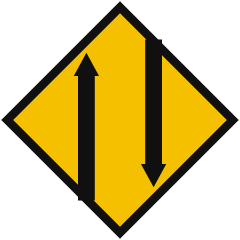
4. Which action becomes clearly more risky beyond this sign?
Show answer
Answer A: Using the left side of the roadway to overtake
With vehicles coming the other way on the same pavement, overtaking on the left needs enough clear road to pull out, pass and return, which is often not available.
-
5. Can an Idaho driver break the basic rule law while traveling below the posted speed limit?
Show answer
Answer C: Yes, if the speed is too slow for conditions and impedes the safe flow of traffic
Idaho's basic rule requires a speed that is reasonable and prudent, so driving too slowly for conditions and impeding the safe flow of traffic breaks the law even below the posted limit.
-
6. A friend asks for a ride and has no gear at all. What is the correct approach?
Show answer
Answer A: Provide a certified helmet, eye protection and covering clothing
A passenger hits the ground the same way the rider does, so a passenger needs the same protection: a certified helmet, eye protection, gloves, boots and covering clothing.
-
7. Your motorcycle has a grab rail behind the passenger seat. What should the passenger know about using it?
Show answer
Answer C: It is fine to hold, but they must still brace against acceleration
A rail behind the passenger gives a secure grip but does nothing to stop them sliding backward, so they still need to expect the machine to pull away.
-
8. When should a staggered group change to single file?
Show answer
Answer C: In curves, in turns, and when entering or leaving a highway
Curves, turns and highway entrances and exits require the full width of the lane, so the group rides single file at those points.
-
9. You are turning left into a street that is divided by a raised median. Which side should you enter?
Show answer
Answer C: The right-hand roadway, so that you travel on the proper side
A raised median separates two directions of travel, so the turn must be completed into the roadway carrying traffic your way.
-
10. A separate right-turn lane leads onto the cross street and carries a yield sign. What does it require?
Show answer
Answer D: Slowing and giving way to traffic and people, stopping if needed
A yield requires you to slow, give way to traffic in the lane you are joining and to pedestrians, and stop only if that is what safety demands.
-
11. Where is the clutch lever located on a standard motorcycle?
Show answer
Answer D: On the left handlebar
Squeezing the lever on the left handlebar disengages the clutch and interrupts power between the engine and the rear wheel.
-
12. A pedestrian near the curb is staring at a phone and not looking at traffic. What should you do?
Show answer
Answer A: Slow down and be ready to stop, because the pedestrian may step out without looking
Distracted pedestrians step into the street without checking. Assume they have not seen you and give yourself time and space to stop.
-
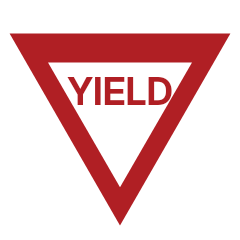
13. A driver passes this sign on an entrance ramp while merging onto a freeway. Who has priority?
Show answer
Answer B: The traffic already traveling on the freeway
The sign places the duty on the entering driver, who must adjust speed and fit into a gap without forcing through traffic to brake or swerve.
-
14. You approach a one-lane bridge and there is a yield sign facing your side of it. What does that mean?
Show answer
Answer B: Oncoming traffic crosses the bridge first and you wait at the approach
At a one-lane bridge the yield sign tells one direction to give way, so you wait clear of the bridge until oncoming traffic has crossed.
-
15. At a four-way stop another driver pulls out ahead of you when it was clearly your turn. What is the correct response?
Show answer
Answer B: Let that driver go through, then take your turn when the way is clear again
Right of way is something you give, never something you take, so yielding to a driver who takes it wrongly avoids a crash you would otherwise share.
-
16. How much more energy must your brakes absorb if you double your speed?
Show answer
Answer D: About four times as much, since energy rises with the square of speed
Kinetic energy grows with the square of speed, so twice the speed means about four times the energy and a far longer braking distance.
-
17. You find yourself in a lane that must turn, you wanted to go straight, and you cannot change lanes safely. What should you do?
Show answer
Answer D: Make the required turn and find another route
Going straight from a mandatory turn lane surprises everyone around you, while a wrong turn costs only a few extra minutes.
-
18. A signal beside a fire station stays dark until apparatus is about to leave, when it shows yellow and then red. What must a driver do?
Show answer
Answer B: Stop on the red and wait until the signal goes dark again
An emergency vehicle signal is a real traffic signal, so its red indication must be obeyed while the apparatus pulls out into the street.
-
19. The light ahead is green, but traffic beyond the intersection is backed up so far that you could not clear it. What is the correct action?
Show answer
Answer D: Wait behind the stop line until there is room on the far side
Entering an intersection you cannot clear blocks cross traffic and pedestrians, so you should hold your position until space opens on the other side.
-
20. Why do experienced riders squeeze the clutch lever while starting the engine, even with the neutral light showing?
Show answer
Answer A: In case a gear is engaged, so the motorcycle cannot lurch forward
A neutral light can be wrong, and a disengaged clutch means the machine stays still even if the transmission is actually in gear.
-
21. How much room should a rider try to leave when passing a line of parked cars?
Show answer
Answer A: Enough to clear an opening door, roughly the width of a car door
A door swings out about the width of a door, so ride at least that far from parked vehicles and slow down wherever you cannot leave that much space.
-
22. Which helmet style gives the rider the most coverage?
Show answer
Answer C: A full face helmet
A full face helmet covers the chin and jaw as well as the skull, protecting the area that open styles leave exposed.
-
23. Which clothing color is most likely to get a rider noticed in daylight?
Show answer
Answer B: Bright orange, yellow or green, which contrast with backgrounds
High visibility colors stand out against road, foliage and vehicles, which helps drivers pick a motorcycle out of a busy background during the day.
-
24. A yellow curve warning sign carries a yellow plaque showing a speed. What does that number mean?
Show answer
Answer D: The recommended maximum safe speed for the curve under ideal conditions
An advisory speed plaque on a yellow warning sign gives the recommended maximum speed for the hazard ahead when conditions are good.
-
25. A broken white line separates your lane from the lane beside it. What does it indicate?
Show answer
Answer C: Both lanes carry traffic in the same direction and lane changes are permitted
White lines separate lanes of traffic moving in the same direction, and a broken white line means changing lanes across it is permitted when it is safe.