
Idaho ITD Motorcycle Practice Test 22
- Questions25
- Correct to pass20
- Passing score80%
- Minimum ageSee note
-
1. What do flashing yellow lights on a school bus mean?
Show answer
Answer A: The bus is about to stop to load or unload, so prepare to stop
The amber lights are the warning phase that comes before the red lights and the stop arm, so drivers should slow down and get ready to stop.
-
2. How far forward should a rider sit on the seat?
Show answer
Answer D: Far enough forward that the arms are slightly bent on the grips
Slightly bent arms let the rider steer with the handlebars instead of using the arms to prop up the upper body.
-
3. Smoke and flames appear from the engine compartment after you stop. What should you do?
Show answer
Answer A: Get everyone well away from the vehicle first, and then call the fire service
A vehicle fire can spread within seconds, so people come out first and firefighting is left to the fire service.
-
4. What tells you that you are following the rider ahead of you too closely in a group?
Show answer
Answer C: You have stopped being able to see the road surface ahead of them
If the machine ahead blocks your view of the pavement it is about to cross, you will not see a hazard until you are already on it.
-
5. If you must abandon a vehicle stuck on the tracks with a train coming, why do you move toward the train and away at an angle?
Show answer
Answer D: Because debris from the impact is thrown forward, away from the train
A train pushes wreckage down the track ahead of it, so walking toward the train and off to the side keeps you out of the debris path.
-
6. You are approaching a blind left hand curve. Which starting lane position gives the best view through it?
Show answer
Answer C: The right portion of your lane
On a left hand bend the outside of the lane is the right side, and moving there lets the rider see farther around the curve before entering it.
-
7. At a stop sign with a painted stop line and a crosswalk, where must you stop?
Show answer
Answer D: At the stop line, before it and before the crosswalk
You stop at the stop line first, and only if there is no stop line do you stop before the crosswalk, and only if there is neither do you stop before entering the intersection.
-
8. A driver ahead of you extends the left arm straight out horizontally through the window. What is being signaled?
Show answer
Answer C: A left turn
The left arm held straight out is the standard hand signal for a left turn.
-
9. Permanent signs must be retroreflective or lighted so that
Show answer
Answer A: they show the same shape and color at night as by day
Retroreflective sheeting throws headlight light back to the driver, so a sign keeps its daytime shape and color after dark.
-
10. Your left-turn lane shows a flashing yellow arrow. What does that indication allow?
Show answer
Answer B: A left turn after yielding to oncoming traffic and to pedestrians
A flashing yellow arrow marks a permissive left turn: the movement is allowed, but oncoming vehicles and pedestrians keep the right-of-way.
-
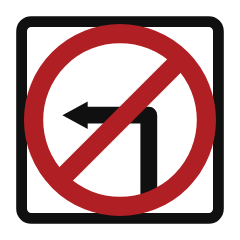
11. A driver in the leftmost lane reaches this sign at an intersection. What must the driver do?
Show answer
Answer B: Go straight on or turn right, and reach the destination another way
The restriction holds whatever the traffic or the signal is doing, so the driver has to pass the intersection and plan a different route.
-
12. How should a passenger behave through a turn?
Show answer
Answer B: Look over the operator's shoulder in the direction of the turn and avoid sudden movement
Looking over the operator's shoulder into the turn keeps the passenger aligned with the motorcycle, and avoiding sudden movement prevents unexpected changes in balance.
-
13. The engine begins to lose power, makes a loud noise and starts to seize. What should the rider do?
Show answer
Answer C: Pull in the clutch at once and coast off the road to a safe place
A seizing engine can lock the rear wheel, and pulling in the clutch separates it from the wheel so the motorcycle keeps rolling under control.
-
14. You have turned right into the nearest lane but you need the left lane soon. When should you move over?
Show answer
Answer A: After the turn is finished, once you have checked mirrors and blind spot
Complete the turn in the proper lane first, then make a normal lane change with mirror and blind spot checks once you are established on the new street.
-
15. You have dropped some distance behind the rest of your group. What should you do?
Show answer
Answer C: Keep your own safe pace, because the group should slow to bring you back
Chasing the group means riding beyond a comfortable pace, so the responsibility sits with the leader to slow down until the formation is whole again.
-
16. A train has just cleared a crossing that carries two sets of tracks. What should you do?
Show answer
Answer B: Wait and look both ways for a second train
A passing train hides a second train on the other track, so wait until the signals stop and you can see that both tracks are clear.
-
17. Compared with dry pavement, how much room does a vehicle need to stop on packed snow?
Show answer
Answer D: Several times as much
Grip on packed snow is a fraction of that on dry pavement, so stopping distance grows several times over. Antilock brakes help you steer, not stop shorter.
-
18. Why is following distance measured in seconds rather than in car lengths?
Show answer
Answer A: Because a time gap automatically grows with speed, while a fixed number of car lengths does not
A gap counted in seconds keeps the same margin of reaction time at any speed, whereas a fixed number of car lengths becomes far too small as speed rises.
-
19. As speed rises, which part of the total stopping distance grows the fastest?
Show answer
Answer B: The braking distance, which grows far faster than speed itself
Perception and reaction distances grow in step with speed, but braking distance grows roughly with the square of speed, so it dominates at higher speeds.
-
20. What is the main source of the noise that damages a rider's hearing?
Show answer
Answer A: Wind turbulence around the helmet, which rises sharply with speed
Wind noise around a helmet is loud enough at highway speed to cause permanent hearing loss over time, which is why earplugs are recommended even on quiet machines.
-
21. A large insect splatters on your face shield and blocks part of your view. What should you do?
Show answer
Answer D: Keep control, look through a clear part, and clean it at the next stop
Taking a hand off the bars or riding with your eyes closed is far more dangerous than a partly obscured view, so keep riding and clean the shield when you are stopped.
-
22. What is the PRIME position on a fuel supply valve used for?
Show answer
Answer D: To let fuel flow into the carburetor after the machine has stood unused
PRIME bypasses the normal vacuum control and lets fuel refill an empty carburetor, which helps a machine start after sitting for a long time.
-
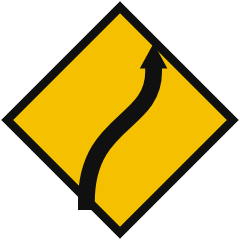
23. A driver holds a steady highway speed into the section this sign warns about. What is the most likely result?
Show answer
Answer B: The vehicle runs wide toward the outside and can cross into another lane or leave the pavement
Holding speed into a change of alignment asks the tires for more side grip than they can supply, so the vehicle runs wide and the driver is left with less room to correct.
-
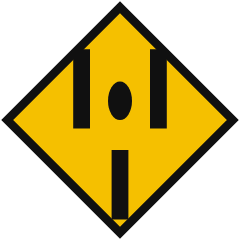
24. What must a driver be ready for beyond this sign?
Show answer
Answer C: Vehicles approaching from the opposite direction in the next lane over
The separation between the two directions runs out, so from that point oncoming vehicles share the same pavement and the driver has to keep right.
-
25. Which shape is used for the school advance warning sign and the school crossing sign?
Show answer
Answer B: An upward-pointing pentagon
The five-sided pentagon with its point up identifies school signing, so the outline alone tells a driver that children may be present.