
Idaho ITD Permit Practice Test 30
- Questions40
- Correct to pass34
- Passing score85%
- Minimum age15 years
-
1. A square sign with a red field, a wide white horizontal bar and the words DO NOT ENTER tells a driver that
Show answer
Answer B: the roadway ahead must not be entered from that point
The do not enter sign is posted at the end of a one-way roadway or ramp to keep traffic from driving into it against the flow.
-
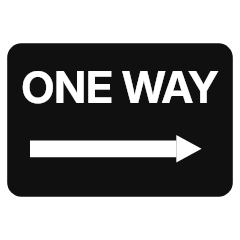
2. A driver on the street this sign governs is preparing to turn left at the next corner. Which lane should the vehicle be in beforehand?
Show answer
Answer A: The lane closest to the left curb
All the traffic here runs the same way, so nothing is coming toward the driver and the turn is taken from the extreme left lane rather than from beside the middle of the roadway.
-
3. What is the correct first step when parallel parking behind an empty space?
Show answer
Answer D: Signal, pull up alongside the vehicle in front of the space, then back slowly into it
Parallel parking is done in reverse from a position alongside the vehicle ahead of the space, because backing in lets the rear wheels guide the vehicle to the curb.
-
4. Enhanced reference location markers differ from ordinary mileposts in that they
Show answer
Answer B: carry the route number and a mileage figure to the tenth of a mile
An enhanced reference location marker adds the route designation and carries the mileage to a tenth, so the point named is far more precise than a plain milepost.
-
5. What range of reinstatement fees does Idaho charge to restore driving privileges after a suspension?
Show answer
Answer B: From $25 to $285, depending on the nature of the suspension
Idaho reinstatement fees run from $25 to $285 depending on the nature of the suspension, and multiple suspensions can carry multiple fees.
-
6. Why is the road often most slippery during the first few minutes of rain after a long dry spell?
Show answer
Answer C: Oil and dust on the surface mix with the water into a slick film
Oil drippings and road dust build up on dry pavement, and the first light rain lifts them into a slippery film before heavier rain washes it away.
-
7. How long may an Idaho driver's license be expired before all applicable knowledge and skills tests must be taken again?
Show answer
Answer D: 25 months or more
If an Idaho or out-of-state Class D license has been expired for 25 months or more, the applicant must retake all applicable knowledge and skills tests.
-
8. The lights at a highway-rail grade crossing begin to flash red as you approach. What must you do?
Show answer
Answer B: Stop short of the tracks and wait until the lights stop and no train is near
Flashing red lights at a crossing require a stop clear of the tracks, and you may proceed only once the lights have stopped, any gates are fully raised and no train is approaching.
-
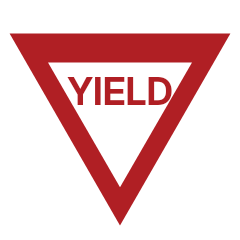
9. A driver reaches this sign and the intersecting roadway is completely clear. What is required?
Show answer
Answer D: Slowing to a speed that allows stopping, then going on without stopping if the way stays clear
This control asks the driver to slow down and be ready to stop, and a full stop becomes necessary only when traffic or pedestrians would otherwise be interfered with.
-
10. You are making a U-turn at a signal on a green left arrow. Who must you still watch for?
Show answer
Answer D: People in the crosswalk you will cross as you come around
Even a protected arrow does not clear the crosswalk, and a U-turn sweeps across a crosswalk that pedestrians may already be using.
-
11. An orange sign reading END ROAD WORK is posted beside the highway. What does it mark?
Show answer
Answer C: The point where the work zone restrictions stop
The sign is installed at the downstream end of the temporary traffic control zone to tell drivers that normal conditions apply again.
-
12. The posted limit is 55 mph, but heavy traffic and rain make that speed unsafe. What does the law expect of you?
Show answer
Answer D: You must slow to a speed that is safe for the conditions
The basic speed rule requires a speed that is reasonable for the traffic, weather and road, and that speed is often well below the posted maximum.
-
13. Why are tall vehicles such as SUVs and vans at extra risk in sudden steering maneuvers?
Show answer
Answer B: Their higher center of gravity makes them more likely to roll over
The higher a vehicle's mass sits, the more it leans in an abrupt turn, and a sharp swerve can tip it over. Smooth, gradual steering inputs are essential in tall vehicles.
-
14. An orange sign showing the symbol of a person holding a flag or a sign paddle means that
Show answer
Answer D: a person is controlling traffic ahead and the driver must obey that person
The flagger sign warns that a trained flagger is directing traffic further on, and the flagger's instructions govern movement through the work zone.
-
15. You reach a T intersection where the cross street has a ONE WAY sign pointing to the right. What may you do?
Show answer
Answer B: Turn right only, because the street carries traffic in that direction
The arrow shows the only direction traffic may travel, so the only legal movement from the terminating road is a right turn.
-
16. On a street with parking along the curb, the shared lane marking is painted well out from the curb face. What does that placement tell a bicyclist?
Show answer
Answer C: To ride clear of the doors of parked cars
The marking is set at least eleven feet from the curb where parking is allowed so that riders are guided outside the reach of an opening door.
-
17. A delivery truck is parked in your lane and you must use the oncoming lane to get around it. Who has the right of way?
Show answer
Answer D: The oncoming traffic, because their lane is clear
The driver whose own lane is obstructed waits, because using the other lane is a favor from oncoming traffic, not a right.
-
18. Why can a motorcycle ahead of you slow down without any warning light showing?
Show answer
Answer B: The rider may slow by downshifting or rolling off
Riders often lose speed by closing the throttle or changing down, which does not switch on the brake light, so watch the machine itself and keep back.
-
19. You are stopped at a red light ready to turn right when a person pushing a stroller steps into the crosswalk. What should you do?
Show answer
Answer A: Stay stopped until they have crossed your path
A turn on red gives way to every pedestrian in the crosswalk, and someone pushing a stroller has even less room to react.
-
20. How should a turn at an intersection be taken on a wet road?
Show answer
Answer C: Slow earlier than usual and steer smoothly through the corner
Wet pavement leaves less grip, so the speed must come off before the turn and the steering must be gentle enough not to break traction.
-
21. You want to turn right at a steady red light and no sign prohibits the turn. What is required?
Show answer
Answer B: Come to a complete stop, then yield to traffic and pedestrians before turning
A right turn on a steady red is permitted only after a complete stop and only after yielding to cross traffic and to pedestrians, and a posted sign can prohibit it entirely.
-
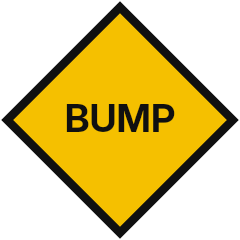
22. How should a driver respond to this sign?
Show answer
Answer C: Slow down before reaching the rough spot and cross it at a steady, low speed
Losing speed before a sharp rise in the pavement keeps the vehicle settled, while braking or accelerating on top of it unsettles the suspension and costs grip.
-
23. Does using a hands free device remove the risk of distraction?
Show answer
Answer A: No, the conversation still takes attention away from driving
Hands free equipment removes the manual part of the distraction but not the mental part, and a driver deep in conversation can look straight at a hazard without registering it.
-
24. At what tread depth should a tire be replaced?
Show answer
Answer A: When the tread is worn down to 2/32 of an inch
At that depth a tire loses grip quickly, especially on wet roads, and the built in wear bars or the penny test both show when the point has been reached.
-
25. You pull onto a soft grass verge to park. What is the main risk?
Show answer
Answer A: The wheels can sink and the car can slide toward the ditch
Soft ground gives way under the weight of a vehicle, and a car that settles or slides sideways can end up stuck or in the ditch.
-
26. The gates at a railroad crossing begin to come down as you approach. What must you do?
Show answer
Answer A: Stop and wait until the gates are fully raised and the lights stop flashing
Once the gates start down you must stop clear of the tracks and wait until they are fully raised and the warning lights have stopped.
-
27. You have parked but your car sits across the line into the next space. What should you do?
Show answer
Answer B: Pull out and park again fully inside one space
A car over the line takes a space away from someone else and leaves too little room for the doors of the vehicles beside it.
-
28. What color scheme does a standard stop sign use?
Show answer
Answer B: White legend and border on a red background
The stop sign carries a white legend and border on a red background, the color set aside for stop, yield and prohibition messages.
-
29. You have just passed a large truck on the freeway. Why is it dangerous to pull back in front of it and then brake for your exit?
Show answer
Answer B: A loaded truck needs much more distance to stop than a car
A fully loaded tractor-trailer can need the length of a football field or more to stop from highway speed. Cutting in and braking leaves the driver no room to avoid hitting you.
-
30. Who does Idaho's open container law apply to?
Show answer
Answer D: Both drivers and passengers
Idaho prohibits both drivers and passengers from drinking or possessing an open container of alcohol in a vehicle.
-
31. What does Idaho law say about speed contests on public roads?
Show answer
Answer C: Any race, speed exhibition or speed contest on a public road is illegal
Idaho makes it illegal to engage in any vehicle race, speed exhibition or speed contest on any public road, street or highway.
-
32. Traffic is entering the freeway from a ramp ahead of you and you are in the right lane. What should you do?
Show answer
Answer C: Move to another lane if it is safe, or adjust your speed to make room
Merging drivers may have little room to adjust. Helping them in by changing lanes or easing your speed prevents conflicts even though they must legally yield to you.
-
33. You have a steady green ball to turn left, and the oncoming traffic gets a green left arrow. What does that mean for you?
Show answer
Answer C: Oncoming vehicles will turn across your path, so you must wait
A green ball is permissive, so when the oncoming side receives a protected arrow those vehicles have priority and you must yield until they clear.
-
34. You are backing straight down a driveway while looking over your right shoulder. Where should your left hand be?
Show answer
Answer C: At the top of the steering wheel, holding it with a firm grip
With one hand at the top of the wheel you can hold a straight course and make small corrections while your body is turned to look behind.
-
35. You decide to turn around using a driveway on your right. What is the safer way to do it?
Show answer
Answer C: Stop past the driveway, reverse into it, then pull out and drive away
Passing the driveway and backing in means you reverse off the roadway and then rejoin traffic facing forward, with a full view of both directions.
-
36. A sign on a divided highway reads Keep Right Except to Pass. What does it require of you?
Show answer
Answer A: Use the left lane only to overtake, then return to a lane on the right
The left lane on such a highway is reserved for overtaking, so a driver who has finished a pass must move back to the right.
-
37. How long does an Idaho driver have to request a hearing on an administrative license suspension?
Show answer
Answer A: Seven days from the date on the notice of suspension
Idaho allows seven days from the date on the notice of suspension to request an administrative hearing before a hearing officer designated by the department.
-
38. As a center two-way left-turn lane reaches an intersection, the markings change into a single left-turn lane. What does that mean for you?
Show answer
Answer D: From that point it serves one direction only, so use it just to turn left
Where the shared lane becomes a marked turn bay it belongs to one direction of travel, and only vehicles making that left turn may occupy it.
-
39. You are driving on a divided highway and see a solid yellow line along the left side of your lanes. What does it tell you?
Show answer
Answer D: It marks the left edge of the roadway for your direction
On a divided highway or a one-way roadway, the left edge of the traveled way is marked with a solid yellow line.
-
40. A lane is marked with a large white bicycle symbol and chevrons, but there is no separate bicycle lane. What does it mean?
Show answer
Answer A: Bicyclists may use the whole lane, so follow or pass with care
A shared lane marking shows that bicyclists and drivers use the same lane and positions riders away from parked car doors, so passing means changing lanes.