
Idaho ITD Permit Practice Test 19
- Questions40
- Correct to pass34
- Passing score85%
- Minimum age15 years
-
1. Someone has stepped into a marked crosswalk in the middle of a block ahead of you. What should you do?
Show answer
Answer A: Slow down, stop before the markings and let the person cross the street
A marked mid-block crosswalk carries the same duty as one at a corner: give way to the person crossing, stopping if that is what letting them cross safely takes.
-
2. What counts as a complete stop at a stop sign?
Show answer
Answer C: The wheels stop turning before the stop line
A legal stop means the vehicle is no longer moving, made at the stop line or before entering the crosswalk or intersection.
-
3. While you wait for the ambulance at a crash, what is the most useful help you can give?
Show answer
Answer C: Keep the person still and warm, and press down firmly on any heavy bleeding
Keeping an injured person still and warm and controlling bleeding are among the few things a bystander can safely do.
-
4. A sign showing a figure with an outstretched thumb inside a red circle with a slash means that
Show answer
Answer B: soliciting a ride is prohibited there
The no hitchhiking sign bars standing beside the road to solicit a ride, and it is common along freeway ramps and shoulders.
-
5. A black and white regulatory sign facing traffic at a divided section reads KEEP LEFT. What does it require?
Show answer
Answer D: Passing the island or obstruction on its left side
Keep Left is posted at an island or obstruction that traffic must pass on the left, which is the opposite of the far more common Keep Right situation.
-
6. What is the correct order of a pass on a two-lane road?
Show answer
Answer A: Check ahead and behind, signal left, move out, accelerate past, signal right and return
A pass begins with the decision that the road is clear and ends with a signaled return, and each step warns other drivers before the vehicle moves.
-
7. Idaho public school driver training courses are open to residents of which ages?
Show answer
Answer D: Between 14 and a half and 21 years of age, whether or not they attend that school
Idaho opens the public school driver training courses to all residents between 14 and a half and 21, even when they are not public school students.
-
8. You are already inside an intersection when you realize you should be in the lane beside you. What should you do?
Show answer
Answer C: Stay in your lane through the intersection and change lanes afterwards
Drivers in an intersection are watching for cross traffic and turning vehicles, so an unexpected sideways move there is easily missed.
-
9. Why does even a small reduction in speed matter so much where people are walking?
Show answer
Answer D: Because a pedestrian struck at a lower speed is far more likely to survive
The chance that a pedestrian survives falls steeply as impact speed rises, so a few miles per hour can decide the outcome.
-
10. This sign comes into view ahead of a driver who has already started along a ramp. What should the driver do?
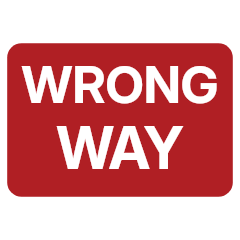
Show answer
Answer B: Pull clear where it is safe, then turn around and leave the ramp traveling properly
The driver is traveling against the legal flow, so the safest response is to stop clear of the lanes, turn the vehicle around and get off the ramp before meeting traffic head on.
-
11. In near freezing weather, which part of an otherwise clear road is most likely to still be icy?
Show answer
Answer D: A shaded dip under trees or beside a rock cut
Sun clears most of the road, but shaded hollows never warm up and can hold ice long after the rest of the pavement is dry.
-
12. When is it appropriate to use cruise control?
Show answer
Answer B: On a dry, open highway with light traffic
Cruise control suits steady conditions where you rarely need to change speed. It is a poor choice in traffic, on curves, on slippery roads or when drowsy, because it removes you from the speed decision.
-
13. Where does the restriction that starts at this sign come to an end?
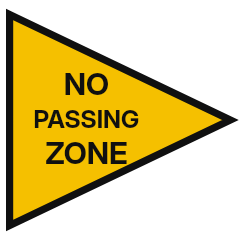
Show answer
Answer D: Where the centerline markings show that overtaking is allowed again
The sign marks the start of the restricted section, and the centerline markings along the road show how far it runs and where overtaking becomes lawful again.
-
14. You arrive at an intersection with no signs, no signals and no markings at the same time as a vehicle on the road to your right. What must you do?
Show answer
Answer B: Yield to the vehicle on your right
At an uncontrolled intersection you must yield to a vehicle already in the intersection or approaching from your right.
-
15. A parking space is marked with the international symbol of access. Who may use it?
Show answer
Answer A: Only a vehicle displaying the required placard or plate
Accessible spaces may be used only by a vehicle that displays a valid disability placard or plate, no matter how short the stop would be.
-
16. You are on a country road with no sidewalk and two people are walking toward you on your side of the shoulder. What should you do?
Show answer
Answer C: Slow down and move over to give them room
Where there is no sidewalk, people are expected to walk on the shoulder facing traffic, and drivers must slow and give them space.
-
17. You have driven at 70 mph for an hour and then exit onto a town street. What is the common risk?
Show answer
Answer B: Your sense of speed adapts, so 35 mph feels slow and you drive too fast
After a long stretch at high speed the brain adapts, so town speeds feel unnaturally slow; check the speedometer instead of trusting the feeling.
-
18. In plain words, what is oversteer?
Show answer
Answer C: The rear of the vehicle slides out and the car turns too sharply
Oversteer means the rear tires have lost grip first, so the tail swings out and the vehicle turns more than you asked it to.
-
19. Why is standing water across a road dangerous even when it looks shallow?
Show answer
Answer B: It can hide a washed out roadbed, a deep hole or a missing cover
You cannot see the surface under the water, and floods commonly wash the roadbed away or lift covers off drains.
-
20. What is the main function of the guide sign series?
Show answer
Answer D: To identify routes and lead road users to their destinations
Guide signs identify routes, name destinations and give distances, so drivers can navigate without stopping to consult a map.
-
21. You are stopped at a steady red arrow pointing right, and no sign or state rule permits turning on a red arrow. May you turn right?
Show answer
Answer A: No, you must wait until the red arrow goes out and a green signal appears
A steady red arrow prohibits the movement it points to until a signal permitting it appears. Only a posted sign or a specific state rule allows a turn on a red arrow after a complete stop, so without one you must wait.
-
22. What is the minimum age to take the Idaho Class D knowledge and skills tests?
Show answer
Answer B: 15 years old
Idaho requires applicants to be at least 15 years of age before they may take the Class D knowledge and skills tests.
-
23. A school crossing guard steps into the roadway and holds up a stop paddle. What must you do?
Show answer
Answer D: Stop and stay stopped until the guard and the children have left the road
A crossing guard directs traffic with legal authority; you must remain stopped until both the guard and the children are clear of the roadway.
-
24. You are on a city street with two lanes in your direction, cars parked along the curb and driveways every few yards. Which lane is usually safer?
Show answer
Answer B: The lane farther from the curb, away from opening doors and vehicles pulling out
Most of the hazards on such a street come from the curb side, so the inside lane gives you more space and more time to react.
-
25. Why should you avoid parking over tall dry grass or a pile of dead leaves?
Show answer
Answer B: Because the hot exhaust can set the dry material on fire
The exhaust system stays hot for a long time after a drive and can ignite dry vegetation underneath the vehicle.
-
26. Loose gravel has been swept into the middle of your lane on a downhill bend. Which controls are affected most?
Show answer
Answer D: Steering and braking, since the loose stones roll under the tires
Gravel rolls between rubber and pavement, so the tires can neither turn the vehicle nor slow it as they would on a clean surface.
-
27. Warning signs such as stop ahead, yield ahead and signal ahead are installed mainly where
Show answer
Answer B: the traffic control device cannot be seen from far enough away
These advance warning signs are used when a crest, curve or obstruction keeps the stop sign, yield sign or signal from coming into view in time for a driver to react.
-
28. Is an SR-22 certificate accepted as the proof of insurance carried in the vehicle for an Idaho skills test?
Show answer
Answer B: No, an SR-22 is not valid proof of insurance for this purpose
Idaho requires valid paper or digital proof of insurance to be in the vehicle for the skills test and states that an SR-22 is not valid proof of insurance.
-
29. You reach an intersection showing a steady red light, and a stop line is painted across your lane. Where must you bring the vehicle to a complete stop?
Show answer
Answer C: Before the stop line
A steady red requires a complete stop before the marked stop line. Where there is no stop line you stop before the crosswalk, and where there is neither, before entering the intersection.
-
30. At a four-way stop you and an opposing driver arrive together. You are going straight and the other driver is turning left across your path. Who goes first?
Show answer
Answer B: You do, because the left turn crosses your path
When two opposing drivers arrive together, the one going straight goes first and the left-turning driver yields.
-
31. The accelerator sticks open while you are driving. What is the first thing to do?
Show answer
Answer A: Shift into neutral and brake while steering off the road
Neutral disconnects the engine from the wheels so the vehicle can be braked normally, while shutting off the ignition may lock the steering and remove power assistance.
-
32. You stop at a rest area because you are sleepy. How long a nap is usually recommended?
Show answer
Answer D: About fifteen to twenty minutes
A short nap of fifteen to twenty minutes restores useful alertness without leaving the grogginess a longer sleep can bring, and you should wait a few minutes before driving on.
-
33. You are waiting in a left-turn lane at a green light when a fire engine with lights and siren comes toward you in the oncoming lanes. What should you do?
Show answer
Answer D: Hold your position and let the fire engine pass
Turning across the path of an approaching emergency vehicle is exactly what you must not do; stay put until it has gone by.
-
34. At highway speed, a large object suddenly appears in your lane and there is open space beside you. Which response is often the most effective?
Show answer
Answer B: Steer around it, since at speed you can often turn quicker than you can stop
Above roughly 25 mph, stopping distance is long while a lane change takes only a moment. When space is available, a controlled steer around the hazard avoids the impact.
-
35. Why should you set the parking brake even when an automatic transmission is in Park?
Show answer
Answer B: Because it takes the strain off the transmission and holds the vehicle
The parking pawl is a small part carrying the whole vehicle; the parking brake shares that load and holds the vehicle if the pawl fails.
-
36. You are waiting inside the intersection to turn left when your light turns red. What should you do?
Show answer
Answer A: Complete the turn as soon as the way is clear
Once you have legally entered the intersection you should clear it as soon as the oncoming traffic has stopped, rather than sit in the path of cross traffic.
-
37. May you stop in a marked bicycle lane to let a passenger out?
Show answer
Answer B: No, stopping there forces riders into the traffic lane
A vehicle stopped in a bike lane pushes riders out into moving traffic, which is exactly what the lane exists to prevent.
-
38. What does a second failure of an evidentiary test within five years bring in Idaho?
Show answer
Answer B: A one-year suspension with absolutely no driving privileges of any kind
A second failed evidentiary test within five years suspends Idaho driving privileges for one year, with no driving of any kind permitted.
-
39. You are the first to arrive at a crash on a rural road. What should you do first?
Show answer
Answer C: Park well clear of the scene, put on your hazard lights and call for help
Getting trained help on the way and keeping the scene visible does more good than anything an untrained bystander can do.
-
40. What is a marked loading zone for?
Show answer
Answer A: Loading and unloading only, not for general parking
A loading zone is reserved for actively loading or unloading goods or passengers; leaving a vehicle there for other reasons is a parking violation.