
Idaho ITD Permit Practice Test 14
- Questions40
- Correct to pass34
- Passing score85%
- Minimum age15 years
-
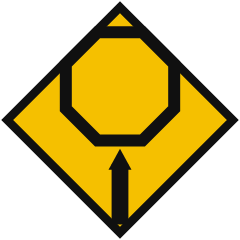
1. On a wet road, how should a driver adjust after passing this sign?
Show answer
Answer B: Start braking earlier, because a slippery surface lengthens the stopping distance
A wet surface lengthens stopping distance, so the extra warning distance should be spent braking gently and early instead of late and hard.
-
2. What does black ice usually look like from the driver seat?
Show answer
Answer C: A patch of pavement that simply looks wet or slightly glossy
Black ice is clear, so you see the dark road through it and read it as a wet patch. In freezing weather, treat any wet looking patch as ice.
-
3. You want to move into the right lane just as an entrance ramp joins the highway at that point. What is the better choice?
Show answer
Answer B: Wait until you are past the merge area so you do not squeeze the entering traffic
The merge area is where ramp traffic has to find a gap, so adding a lane change of your own into the same space creates a conflict.
-
4. Can an Idaho driver break the basic rule law while traveling below the posted speed limit?
Show answer
Answer C: Yes, if the speed is too slow for conditions and impedes the safe flow of traffic
Idaho's basic rule requires a speed that is reasonable and prudent, so driving too slowly for conditions and impeding the safe flow of traffic breaks the law even below the posted limit.
-
5. Is dictating a message by voice a safe alternative to typing one?
Show answer
Answer C: No, it still takes attention from driving
Composing and checking a spoken message loads the mind and usually pulls the eyes to the screen anyway, so research finds it no safer than other phone use.
-
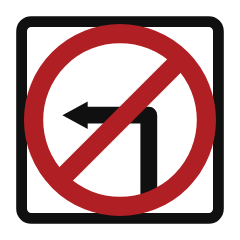
6. A driver in the leftmost lane reaches this sign at an intersection. What must the driver do?
Show answer
Answer B: Go straight on or turn right, and reach the destination another way
The restriction holds whatever the traffic or the signal is doing, so the driver has to pass the intersection and plan a different route.
-
7. The vehicle you have borrowed is larger and heavier than your own. How should you drive it?
Show answer
Answer B: Allow more room for stopping and for turns until you are used to it
Extra weight and length mean longer stopping distances and wider turns, so give yourself more room until you are used to it.
-
8. Your light turns green, but a vehicle is still in the middle of the intersection. What should you do?
Show answer
Answer D: Wait until the intersection is clear before you move ahead
A green light means go only when the way is clear. Drivers already inside the intersection must be allowed to finish crossing.
-
9. Rain is heavy enough that you have your windshield wipers running. What else should you switch on?
Show answer
Answer A: Your headlights, so you can see and others can see you
Rain heavy enough to need wipers also cuts how far away you can be seen, so the headlights belong on. Many states write this into law as a wipers on, lights on rule.
-
10. When is switching traction control off sometimes useful?
Show answer
Answer A: When you need spinning wheels to rock out of deep snow or mud
Rocking a stuck vehicle free needs the wheel spin that the system normally prevents. Switch it back on as soon as you are moving again.
-
11. What should you avoid when a hostile driver pulls alongside you?
Show answer
Answer A: Making eye contact, or answering the gestures in any way at all
Any response, including a look, encourages an aggressive driver, so give none and let the vehicle go.
-
12. Your vehicle stalls on a railroad crossing and will not restart. What should you do first?
Show answer
Answer A: Get everyone out and away from the tracks immediately
Everyone must leave the vehicle and move well clear of the tracks at once, walking toward the train at an angle so that debris from an impact travels away from you.
-
13. A large electronic advertising sign beside the road catches your eye. What should you do?
Show answer
Answer A: Glance briefly and return your eyes to the road
Bright changing displays are designed to hold attention, so treat them like any roadside object and give them no more than a brief glance.
-
14. Which practice matches current child passenger safety guidance?
Show answer
Answer D: Keep a child rear facing until the top height or weight limit of the seat is reached
A rear facing seat spreads crash forces across the child's whole back, so it should be used as long as the seat allows, and never in front of an active passenger air bag.
-
15. Traffic is heavy and crawling where a sign warns that your lane ends and two lanes must become one. What is the best practice?
Show answer
Answer C: Use the lane to the end, then take turns merging one by one
In stop-and-go traffic the zipper merge, using both lanes up to the merge point and then alternating, keeps the queue shorter and traffic moving; in free-flowing traffic move over as soon as it is safe.
-
16. Some crosswalks are marked with two transverse lines and others with a row of wide bars laid along the direction of travel. Why is the second pattern used?
Show answer
Answer B: It is far easier for an approaching driver to see
Longitudinal bar patterns are used where extra visibility is wanted, such as an uncontrolled crossing or one near a school, because they show up much better from a car.
-
17. How many points does an Idaho Traffic Safety Education Course remove?
Show answer
Answer C: A number matching the points attached to the citation, up to a maximum of four
The number of points removed by the Traffic Safety Education Course matches the points attached to the citation, and the course removes at most four.
-
18. The school bus stop ahead sign is installed where
Show answer
Answer C: a school bus stop cannot be seen from far enough away by approaching drivers
This school warning sign is used in advance of a bus stop that lacks adequate sight distance and cannot be relocated, so drivers are warned before the stopped bus comes into view.
-
19. You are stopped at a T-intersection and a driver on the through road is signaling a right turn into your road. What is the safe assumption?
Show answer
Answer B: The driver may not actually turn, so wait until the vehicle slows and starts turning
A blinking signal may have been left on by mistake or may be for the next street, so wait until the vehicle actually slows and turns.
-
20. Two left-turn lanes are available and you must turn right again a short distance after the turn. Which of the two should you use?
Show answer
Answer D: The right one, so you finish nearer the right side of the new street
Each turn lane feeds the matching lane of the new street, so choosing the right-hand of the two left-turn lanes leaves you closer to the side you will need.
-
21. You have fitted the small temporary spare tire after a flat. What should you keep in mind?
Show answer
Answer C: It is meant for low speed and short distances until the regular tire is repaired
Compact spares have limited grip, handling and durability. Follow the speed and distance limits printed on the tire and get the regular tire fixed soon.
-
22. When may you stop on the shoulder of a freeway?
Show answer
Answer A: Only in an emergency, moving completely off the travel lanes and switching on your hazard lights
The freeway shoulder is reserved for emergencies and for disabled vehicles, and a vehicle stopped there must be clear of the travel lanes with hazard lights on.
-
23. On a highway with mileage-based exit numbering, you have just passed exit 42 and are looking for exit 55. About how far is it?
Show answer
Answer B: Thirteen miles
With mileage-based numbering each exit takes the number of the nearest milepost, so subtracting one exit number from another gives the distance in miles.
-
24. How long does a parallel parking space need to be for the car you are driving?
Show answer
Answer D: About five or six feet longer than your vehicle
A few extra feet at each end give you the room to swing in and to straighten up without touching the vehicles in front or behind.
-
25. How do worn tires and worn brakes affect your ability to stop?
Show answer
Answer C: They lengthen the stopping distance, especially on a wet road
Worn tread cannot clear water and worn brakes cannot produce full force, so both stretch the distance needed to stop.
-
26. You realize you have driven several miles without remembering any of it. What kind of distraction is this?
Show answer
Answer C: Cognitive distraction, because your mind was not on driving
Daydreaming or being lost in thought is a cognitive distraction. Your eyes may be on the road, but your brain is not processing what they see.
-
27. A flagger turns the paddle to the orange face reading SLOW. What does that tell approaching drivers?
Show answer
Answer D: Reduce speed and continue through the work area with care
The SLOW face keeps traffic moving at a reduced speed while workers or equipment are close to the travel lanes.
-
28. You are in the middle lane of a one-way street with three lanes when a police car approaches from behind with lights and siren. What should you do?
Show answer
Answer C: Pull to the nearest curb and stop clear of the lanes
On a one-way street you clear to whichever curb is closest, so the emergency vehicle gets a clear path down the open lanes.
-
29. A yellow diamond in which one line joins another at an angle warns that
Show answer
Answer B: traffic from another roadway will merge into the driver's lane ahead
The merge sign warns that another traffic stream will join the same lane ahead, so drivers on both roadways must adjust speed and spacing.
-
30. Your passengers are being noisy and you are losing concentration. What should you do?
Show answer
Answer B: Ask them to settle down, or pull over safely until they do
The driver is responsible for the conditions inside the vehicle, and stopping is always better than driving distracted.
-
31. Drivers from which country may keep their foreign license and skip the Idaho skills test?
Show answer
Answer D: Germany
Idaho exempts drivers from Germany from both surrendering the foreign license and taking the skills test, while drivers from Korea or Taiwan who keep their license must take the skills test.
-
32. You come upon a crash that has just happened and decide to help. Where should you stop your vehicle?
Show answer
Answer A: Well beyond the scene, completely off the road, with the hazard lights on
Stopping past the crash and off the pavement keeps you from becoming another victim and leaves the approach clear for emergency vehicles.
-
33. A line beside your lane is painted about twice the normal width. What does the extra width convey?
Show answer
Answer B: Greater emphasis on the restriction it carries
Width is part of the marking code: a wide line carries more emphasis than a normal one, which is why it is used at gores and channelizing lines.
-
34. You are entering a freeway using an on-ramp with an acceleration lane. What is the correct technique?
Show answer
Answer C: Use the acceleration lane to reach the speed of traffic, then merge into a gap while yielding to traffic already on the freeway
The acceleration lane exists so you can match the speed of freeway traffic before merging, and drivers already on the freeway have the right-of-way.
-
35. How far ahead should you normally be looking while driving?
Show answer
Answer D: About 12 to 15 seconds of travel ahead
Looking that far ahead, roughly a block in town and much farther on a highway, gives you time to see a problem developing and adjust before it becomes an emergency.
-
36. You are turning right from a one-way street onto a two-way street. Where should the turn end?
Show answer
Answer A: In the lane nearest the right curb of the street you are entering
A right turn starts and finishes as close to the right as practical, so you leave the one-way street from the right lane and arrive in the lane nearest the right curb.
-
37. A diamond-shaped sign is used to
Show answer
Answer A: warn of a condition on or next to the road that may call for caution
The diamond is the standard shape of the warning series, which alerts drivers to conditions that would otherwise not be obvious in time to react.
-
38. You have printed directions or paperwork you need to check. When should you read them?
Show answer
Answer C: Before you leave, or after you park
Reading takes eyes and mind off the road for far longer than any safe glance, and a light that changes while you read leaves you moving off blind.
-
39. How much should you normally reduce your speed on a road covered with packed snow compared with dry conditions?
Show answer
Answer C: By about half
Packed snow roughly doubles the distance needed to stop, so a common guideline is to cut speed by about half. On ice, slow to a crawl.
-
40. The driver of a slow farm vehicle moves partly onto the shoulder and waves you past. Who is responsible for the pass?
Show answer
Answer A: You are, so pass only if you can see that the road is clear
A courtesy wave is not a traffic control, and the driver who changes lanes is the one answerable for the maneuver.